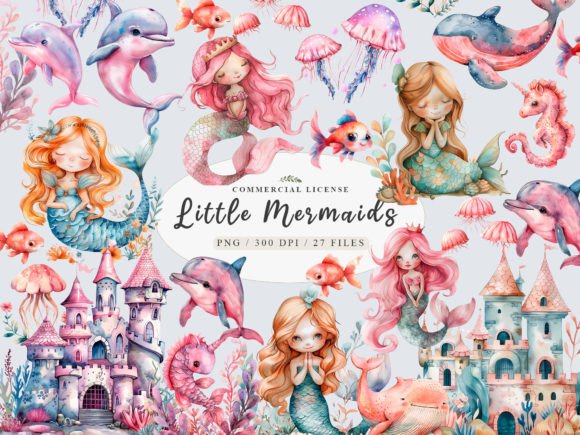
Little Mermaid Png & Cute Mermaid Clipart
If you have spent any time sourcing visuals for a coastal brand, children’s book layout, or whimsical social campaign, you have likely noticed that mermaid imagery runs the gamut from hyper-realistic to cartoonish, from dark and moody to light and breezy. The sweet spot for many creators sits squarely in the middle: the kind of artwork that feels charming without being juvenile, polished without feeling stiff. That is exactly where Little Mermaid Png and Cute Mermaid Clipart assets live. These are not the heavily airbrushed mermaids of stock photo catalogs nor the rudimentary clipart of early web design. Instead, they represent a modern, versatile category of design assets that blend fantasy with approachable warmth.
Think soft pastel palettes, gentle curves, expressive eyes, and just enough detail to read beautifully across formats. Hair flows in stylized waves, tails shimmer with subtle scales, and the overall mood leans friendly, magical, and slightly whimsical. This visual personality makes the assets immediately recognizable yet flexible enough to pair with other design elements without fighting for attention. For anyone building a brand or creating content that needs a touch of underwater charm without tipping into saccharine territory, this style offers a reliable foundation.
Visual Characteristics That Drive Engagement
The strongest Little Mermaid Png and Cute Mermaid Clipart sets share a few consistent traits. Line work tends to be clean but not rigid, giving the illustrations a handcrafted feel that resonates with audiences tired of generic vectors. Color choices often lean toward coral, seafoam, lavender, and soft gold, creating an instant emotional connection to ocean themes without relying on obvious blues alone. The mermaids themselves typically have rounded facial features, small noses, and large eyes that convey curiosity or delight, which is a deliberate design choice. Research on visual processing shows that humans respond positively to neotenous features, making characters feel trustworthy and approachable.
Beyond the characters themselves, the best clipart includes supporting elements like seashells, starfish, waves, bubbles, and underwater plants, all rendered in the same cohesive style. This matters because it allows you to build complete scenes without mixing aesthetics from different artists. When every element shares a consistent line weight, texture, and color philosophy, the final composition looks intentional rather than cobbled together. For a small business owner designing a product label or a blogger creating a branded freebie, that coherence is invaluable.
Where These Assets Perform Best
In practice, this style of clipart and PNG art thrives across several project types. Packaging design for bath products, candles, teas, and skincare lines frequently uses mermaid motifs, and the cute, approachable style helps the product feel inviting rather than overly themed. A coral-colored mermaid on a lotion label reads as playful elegance, not a costume party. Similarly, editorial design for magazines or online publications targeting young families or creative women can use these assets as spot illustrations, pull quotes, or section headers. The light, airy style breaks up text without overwhelming the page.
For social media graphics, especially on platforms like Pinterest and Instagram, cute mermaid clipart stops the scroll. A well-composed quote card featuring a mermaid silhouette or a bubble-framed text box performs better than plain typography because it taps into the viewer’s emotional desire for beauty and escapism. Marketers running campaigns for ocean conservation, summer events, or children’s products will find that these assets reduce friction in content creation. Instead of commissioning custom illustrations for every post, you can pull from a cohesive set and maintain visual consistency across weeks of content.
Small business owners, in particular, benefit from using Little Mermaid Png files in digital products such as printables, party kits, planners, and coloring pages. Because the files come with transparent backgrounds, they insert directly into Canva, Photoshop, or Publisher without messy cutting out. This saves hours of editing time and allows even non-designers to produce professional-looking materials. A printable birthday invitation with a cute mermaid illustration and a clean serif font can look custom-made in under ten minutes.
How Clipart Shapes Brand Perception and Readability
It is easy to underestimate how much a single illustration style influences how audiences perceive your brand. When you consistently use Cute Mermaid Clipart across your website, email headers, and packaging, you signal that your brand values warmth, creativity, and a touch of wonder. This is especially powerful for businesses in the children’s product, party planning, or wellness spaces, where emotional resonance drives purchasing decisions. The visual style becomes shorthand for your brand personality. A customer who sees that mermaid on your Instagram feed will feel a sense of familiarity when spotting it on your product label, which builds trust over time.
From a readability and visual hierarchy standpoint, these assets function best when treated as accent pieces rather than primary content carriers. A mermaid illustration placed beside a headline directs the eye and adds context, but it should not compete with the text itself. Designers I have worked with find that leaving ample white space around clipart preserves legibility, especially in mobile layouts where screen real estate is tight. The goal is for the illustration to enhance the message, not bury it. When used with restraint, one well-placed mermaid can anchor an entire page layout.
Consistency in brand identity also improves when you limit yourself to one clipart style across all touchpoints. Switching between different mermaid aesthetics, one realistic, one cartoonish, one minimalist, confuses the audience and dilutes recall. By committing to a single cohesive set of Little Mermaid Png assets, you create a visual system that reinforces recognition every time someone encounters your brand. That is the kind of design discipline that separates professional-looking businesses from hobbyist efforts.
Choosing the Right Assets for Your Project
Practical selection starts with evaluating the project’s emotional tone. A mermaid for a children’s birthday party should feel joyful and bright, with bold colors and simple shapes. A mermaid for a luxury bath brand might use softer tones, finer details, and a more elegant pose. Before downloading any clipart, ask yourself what feeling you want the viewer to experience. That answer will guide your choice of color palette, line quality, and character expression far more effectively than any trend.
Next, consider the medium. Web design benefits from PNG files with transparent backgrounds because they layer smoothly over gradients and background images. For print projects, check that the file resolution is at least 300 DPI at the size you intend to use it. Many clipart sellers offer both web and print versions, but it pays to read the product details rather than assume. I have seen too many crafters print a beautiful invitation only to discover the mermaid pixelates at full size. Avoid that disappointment by verifying resolution before purchase.
Commercial licensing is another crucial factor, especially for entrepreneurs and marketers producing physical products or digital downloads for sale. Most reputable clipart creators offer clear licensing terms, often distinguishing between personal use, small business use, and extended commercial use. If you plan to print mermaid clipart on T-shirts, mugs, or sell digital templates that include the artwork, you need the appropriate license. Respecting these terms keeps your business legally sound and supports the artists creating the assets you rely on.
Testing Pairings and Building Cohesive Designs
Once you have chosen your mermaid clipart, the next step is pairing it with typography and other design elements. Because the clipart style is inherently friendly and rounded, it pairs well with sans serif fonts that share similar softness. Think rounded sans, humanist sans, or even a gentle script font for headings. Avoid overly rigid geometric sans or heavy slab serifs, which can clash with the organic feel of the illustration. A good rule of thumb is to match the mood of the typography to the mood of the clipart. If the mermaid feels playful, let the font feel playful too.
For logo design, you may want to use mermaid clipart as a starting point rather than a final mark. A logo should be distinctive and scalable, and clipart is rarely custom enough to serve as a unique logo. However, you can commission a modified version of a clipart style from the original artist, or use the clipart as an interior element within a wordmark. Many small businesses use a mermaid icon beside their business name in a clean display font, which gives them a professional look without the cost of full custom illustration.
In editorial design, try using mermaid clipart as a chapter opener or divider between sections. If your publication or website has a beachy or fantasy theme, repeating the same mermaid motif throughout creates a rhythmic visual experience. Readers may not consciously notice the repetition, but they will feel the cohesive structure. That subconscious consistency is what makes content feel polished and intentional.
Real-World Examples and Practical Recommendations
One indie skincare brand I worked with used a single Cute Mermaid Clipart illustration across their website hero image, product labels, and email newsletter headers. The mermaid was rendered in their brand colors, coral and teal, with minimal background elements. Within three months, they reported that customer surveys started referencing the mermaid as a reason they remembered the brand. That kind of recall is hard to achieve with generic stock photography but becomes almost effortless with a distinctive, consistent character.
For a children’s book self-publisher, a set of Little Mermaid Png files became the entire visual backbone of a 24-page story. Because the clipart included multiple poses, expressions, and scene elements, the author was able to compose each page by layering assets in Photoshop. The result looked cohesive because all illustrations came from the same artist and shared the same line quality and shading. The book sold well on Amazon, and the author later licensed the same clipart for a line of printable activity sheets, extending the value of the initial purchase.
My recommendation for anyone starting out is to invest in one high-quality set rather than collecting dozens of free, mismatched pieces. A premium set of Little Mermaid Png and Cute Mermaid Clipart with 30 to 50 assets, multiple color options, and commercial licensing will serve you for years across countless projects. It becomes a foundational design asset in your toolkit, much like a reliable serif font or a go-to color palette. You will reach for it again and again, and each use will reinforce your brand’s visual identity.
Ultimately, the best clipart is the clipart you actually use. A hundred unused files in a folder provide zero value. Start with one project, build around one mermaid illustration, and see how it transforms your workflow. You may be surprised how much a single charming character can elevate your work from ordinary to memorable.